
For many international patients traveling to Seoul, the goal isn’t simply achieving “larger” eyes. The true objective is achieving a bright, alert, and harmonious look that feels fundamentally you.
However, navigating Korean eye surgery options can feel overwhelming. Patients frequently encounter complex medical terms like ptosis correction (눈매교정) and canthoplasty. Do you need both? Will the results look unnatural or “surprised”? What happens if the delicate corners of the eyes do not heal correctly?
Korea Beauty Guide understands these anxieties deeply. When dealing with the highly complex anatomy of the eyelid, there is no “one-size-fits-all” approach. Below is an objective, insider’s look into the science behind these procedures to help you navigate your surgical journey safely and confidently.
Understanding the Anatomy: Ptosis Correction vs. Canthoplasty
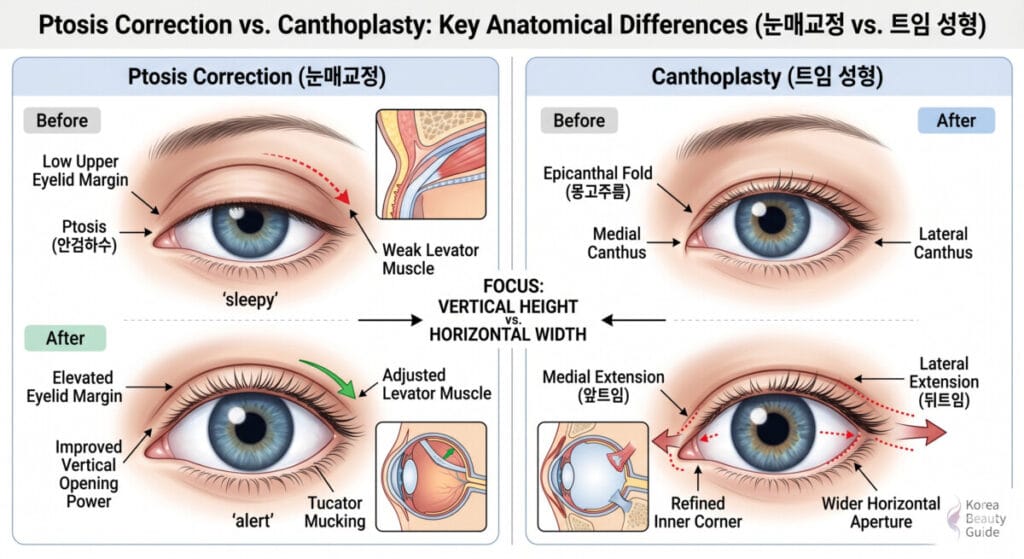
Many patients confuse these two distinct procedures. However, they serve entirely different functional and aesthetic purposes for your overall eye shape.
Ptosis Correction (Fixing the “Curtain Rod”)
Ptosis correction is not merely about creating a cosmetic double eyelid. It is a highly specialized functional procedure designed to improve the eye’s actual opening power.
- The Mechanism: As we age or due to genetics, the levator aponeurosis or Müller’s muscle (the muscles responsible for lifting the eyelid) can weaken. This condition, known as “levator dehiscence,” causes a tired, heavy appearance.
- Why It Matters: If a patient with mild ptosis only receives standard double eyelid surgery, the eyes may still appear sleepy. The underlying muscle simply lacks the strength to lift the lid. A precise muscle adjustment restores true alertness.
- 2026 Korean Clinical Standards: For mild cases, non-incisional techniques utilizing multi-point fixation are highly effective. However, for moderate-to-severe cases—or patients with thicker skin—the incisional method remains the absolute gold standard for reliable, long-term results.
Canthoplasty (The Horizontal and Diagonal Extension)
While ptosis correction changes how the eye opens vertically, canthoplasty fundamentally alters the eye’s shape, width, and aperture.
- Epicanthoplasty (Inner Corner): This refines the inner eye by releasing the Mongolian fold. Modern top-tier Seoul surgeons utilize a “redraping” technique. This hides incisions completely within the eyelid margin, ensuring zero visible scarring.
- Lateral & Lower Canthoplasty (Outer Corner): This expands the outer corner of the eye. The latest 2026 surgical protocols emphasize periosteal fixation. This critical safety step anchors the outer ligament directly to the orbital bone, securely preventing the outer corner from “webbing” or re-attaching over time.
Addressing Your Biggest Concerns: Safety & Recovery
It is completely normal to fear the “surprised” look (scleral show) or chronic dry eye. These complications typically stem from over-aggressive tissue removal or improper muscle anchoring by inexperienced practitioners.
The Truth About Chemosis Recovery
A common concern for international patients undergoing eye shape surgery is chemosis. This is a “jelly-like” swelling of the conjunctiva that frequently occurs after lateral canthoplasty.
- Why It Happens: The surgery temporarily disrupts local lymphatic drainage, causing fluid to pool safely in the thin membranes of the eye.
- The Good News: Chemosis is entirely temporary. With the proper administration of prescribed steroid drops and lubricating eye drops, most swelling completely subsides between weeks two and four.
Why Booking Direct with Clinics Risks Your Results
For international patients, the greatest surgical risk isn’t just the procedure itself. The true danger lies in the isolation of post-operative care in a foreign country. Many “factory-style” clinics prioritize high patient volume over the precise, patient-specific anatomy required for delicate ocular-plastic procedures.
Korea Beauty Guide serves as your ultimate safeguard against these risks. KR Beauty Guide strictly filters out high-volume “factory clinics” and partners exclusively with board-certified Seoul surgeons who specialize in the functional preservation of the eyelid.
How KR Beauty Guide Supports Your VIP Journey
- Elite Specialist Vetting: KR Beauty Guide ensures your selected surgeon prioritizes the protective function of your eyelid just as highly as the aesthetic design.
- VIP Medical Translation: Post-op recovery can feel overwhelming. Korea Beauty Guide provides dedicated medical translators to explain exactly how to manage eye drops, clean incisions, and monitor symptoms like chemosis from the luxury and comfort of your hotel.
- Personalized Surgical Planning: KR Beauty Guide helps you actively avoid the “surprised” look. The surgical plan is meticulously tailored to your unique facial matrix and individual levator muscle strength.
Ready for Your Transformation?
Your eyes are the most expressive feature of your face. Do not leave their vital function and aesthetic beauty to chance.
Contact Korea Beauty Guide today for a complimentary, personalized consultation. The KR Beauty Guide experts will review your eye anatomy and connect you with the safest, most precise medical specialists in Seoul to help you achieve your most natural, refreshed look.