Introduction: Why You Are Always the “Easy Target” in Gangnam
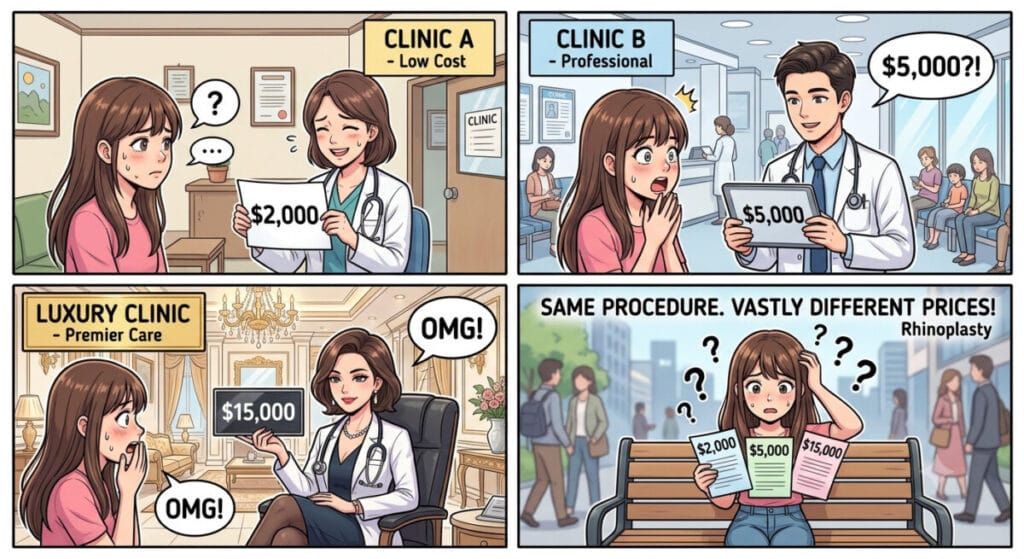
When researching Korean plastic surgery from abroad, international patients quickly run into a frustrating wall of information asymmetry: Why does a primary rhinoplasty cost $3,000 at one clinic in Gangnam, and $8,000 at another right across the street?
Most patients assume that higher prices automatically guarantee superior surgical skill or better safety. However, the reality of Seoul’s medical landscape is far more complex. Behind closed doors, plastic surgery clinics are aggressively competing corporate entities.
To make a safe and financially sound decision, you must look beyond the price tag and understand the hidden mechanics of Gangnam’s medical pricing—and why trying to navigate this landscape alone through Google searches is nearly impossible.
1. The Invisible Cost: Marketing Warfare and the “Foreigner Tax”
One of the most overlooked factors influencing your surgery quote is the clinic’s Customer Acquisition Cost (CAC).
Mega-clinics targeting international patients often operate massive in-house marketing departments, dedicated SEO teams, and video production crews. It is estimated that 25% to 30% of a major clinic’s revenue goes directly into marketing and advertising. Furthermore, attracting a patient from overseas costs significantly more than attracting a local Korean patient.
Additionally, while hospital directors are skilled surgeons, they are rarely marketing experts. Marketing trial-and-error often leads to wasted corporate budgets, which are ultimately passed down to the patient.
This high cost of patient acquisition is a primary driver behind the infamous “Double Pricing” (Foreigner Tax)—where international tourists are quoted significantly higher rates than locals. Unfortunately, unethical medical tourism agencies and brokers often conspire with clinics to inflate these prices even further to secretly pocket massive commissions.
2. Materials, Surgical Options, and the Danger of Aggressive Upselling
The second factor influencing price involves legitimate medical variables: the type of machinery used, the grade of implants, or specific surgical techniques. It is entirely reasonable that a $7,000 estimate might increase by $1,500 if you opt for 100% autologous rib cartilage instead of a standard silicone implant.
However, the real danger lies in aggressive upselling.
When you walk into a clinic for an in-person consultation, your first point of contact is usually a “Consultation Manager” (상담실장). It is crucial to understand that these managers are paid salespeople, not medically trained doctors. Their primary corporate role is to maximize the average revenue per patient.
Without deep medical knowledge or industry experience, it is extremely difficult for a foreign patient to distinguish between a medically necessary surgical option and an unnecessary up-sold procedure designed merely to inflate the clinic’s bottom line.
3. Is Expensive Always Better? The Truth About Facility Costs
Does a higher price tag guarantee better surgery? Yes and no.
Higher prices can reflect critical safety investments. Truly premium clinics allocate substantial budgets to retain full-time, in-house board-certified anesthesiologists, state-of-the-art emergency monitoring systems, and strict “one-doctor-one-room” policies to prevent ghost surgery.
However, price is not a direct reflection of a surgeon’s artistic skill or technical execution. You could pay top dollar at a luxury clinic simply because you are subsidizing their expensive Gangnam real estate rent, massive administrative overhead, and marketing campaigns—not because the doctor is more skilled than a surgeon at a boutique clinic charging half the price.
4. Why Your Google Research is Falling Short
You might think, “I can just research thoroughly online, read reviews, and watch YouTube videos to find the best doctor.”
Here is the uncomfortable truth: Over 90% of the before-and-after reviews, vlogs, and forum recommendations you see online are highly curated, sponsored, or directly funded by clinic marketing budgets.
As an outsider, searching in a second language, you cannot bypass the marketing wall. You cannot see which surgeons are genuinely respected by their peers within the Korean medical community, nor can you discover the “real” local pricing discussed on verified, Korean-only platforms.
Conclusion: Why You Need an Insider on Your Side
Breaking through Gangnam’s information asymmetry requires more than just hours of online research; it requires real-world, industry-level connections.
This is where KR Beauty Guide changes the equation. We are not a traditional broker that partners with a few select clinics to inflate prices and split commissions. We are your independent medical guide and insider advocate.
By combining former in-clinic work experience with authentic, unfiltered local Korean networks, we provide the protection and transparency that international patients desperately need:
- We recommend the doctors whom hospital staff and nurses actually choose for their own surgeries.
- We act as a shield against aggressive upselling by sales managers, filtering out unnecessary procedures.
- We strictly challenge double-pricing, ensuring you receive authentic, standardized local rates.
- We connect you to any top-tier, board-certified surgeon in Seoul—unbiased by exclusive clinic contracts.
You do not have to navigate the complex, high-stakes world of Korean plastic surgery alone. Let an insider secure the safety, honesty, and fair pricing you deserve.
[👉 Ready for an honest, zero-upselling consultation? Talk to our medical guide today.]