
You’ve done your research, chosen the best surgeon, and successfully completed your procedure. But as you look in the mirror the next morning, a new challenge appears: the swelling. For many international patients, the “recovery phase” is the most anxious time. You’re away from home, your face or body is changing daily, and you’re wondering if what you’re seeing is normal.
In my years spent navigating the halls of Seoul’s top clinics, I’ve learned that a “successful surgery” isn’t just about the time spent in the OR—it’s about how you manage the 14 days that follow. Let’s break down the science of swelling and how to get back to your radiant self, faster.
Understanding the Timeline: The “Three-Day Peak”
Swelling is your body’s natural inflammatory response to surgery. In the world of Korean plastic surgery, we generally categorize recovery into two phases:
- The Acute Phase (Days 1–3): This is when swelling and bruising are at their peak. Don’t panic; this is simply your body’s “protection mode.”
- The Subsiding Phase (Days 4–14): Major swelling begins to drop. By the end of week two, most patients feel comfortable enough to go out for dinner or fly home.
3 Essential Pillars to Reduce Swelling Faster
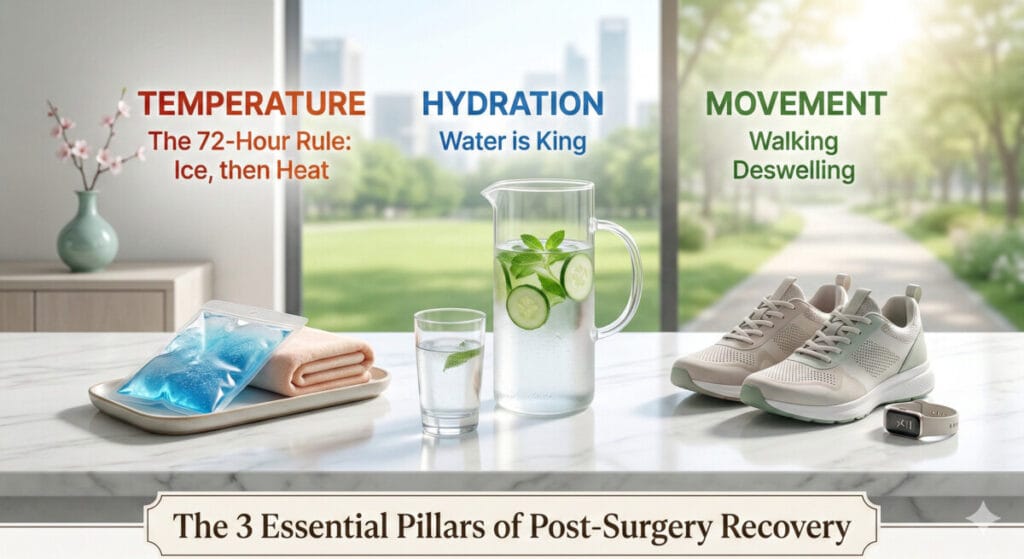
While there are many fancy treatments available, I always tell my clients that 90% of a successful recovery comes down to three fundamental pillars: Temperature, Hydration, and Movement. If you master these three, you are already ahead of the curve.
1. Temperature Control: The “72-Hour Rule”
One of the most common mistakes I see patients make is using heat too early. Managing the temperature of the surgical site is the first step in controlling inflammation.
- First 72 Hours (Ice Packs): Cold constricts blood vessels and minimizes the initial fluid buildup. Use the ice packs provided by the clinic religiously during this window.
- After 72 Hours (Warm Compresses): Once the initial “trauma” has passed, switch to warmth. This improves blood circulation, helping your lymphatic system flush out the remaining fluid and stagnant blood (bruising).
2. Hydration: The Truth About Pumpkin Juice
In Korea, “Pumpkin Juice” (Hobak-jeup) is legendary for deswelling. While it is a helpful natural diuretic, many patients make the mistake of relying on it as a miracle cure.
The real secret isn’t the pumpkin—it’s Hydration.
- Water is King: To flush out anesthesia and metabolic waste, your body needs a constant flow of water.
- The Salt Trap: Proper hydration also means managing your salt intake. High-sodium meals (like spicy Korean stews or processed snacks) cause your body to hold onto water, making your face look significantly more swollen the next day. Think of pumpkin juice as a supplement, but keep your water bottle as your primary tool.
3. Movement: The Power of “Walking Deswelling”
In Korea, surgeons often prescribe “light walking” as if it were medicine. Unlike complete bed rest, which can actually slow down your metabolism and prolong swelling, gentle movement is vital.
- Gravity is Your Friend: A 20–30 minute light stroll helps your circulatory system pump fluids away from the surgical site.
- Stay Upright: Avoid lying flat during the day. Keeping your head above your heart level, even while resting, uses gravity to naturally drain fluid downward.
Enhancing Your Results: Professional De-swelling Treatments
Once you have the three pillars (Temperature, Hydration, Walking) under control, you can look into professional interventions to speed up the process. Most premium clinics in Seoul offer specialized post-operative care:
- LED Deswelling Laser (SmartLux): Uses specific light wavelengths to promote cell regeneration and reduce redness.
- Oxygen Chamber Therapy: Floods your tissues with pure oxygen to accelerate the healing of incisions.
- Radiofrequency (RF) Treatments: Later in the recovery stage, these can help tighten the skin and smooth out any minor lumps or stiffness.
Insider Tip: During my time in the clinics, I noticed that patients who combined the “Three Pillars” with at least two sessions of professional LED therapy recovered nearly 30% faster than those who didn’t.
A Checklist for Your Recovery Kit
Before you arrive in Korea, or during your first day, ensure you have these essentials:
- Extra Pillows: To keep your head elevated at a 30-degree angle while sleeping.
- Button-down Shirts: To avoid pulling clothes over a sensitive face or chest.
- Gentle Cleansing Wipes: Since you may not be able to splash water on your face for several days.
How a Medical Agency Makes the Difference
Managing your own recovery in a foreign country can be overwhelming. This is where a dedicated partner becomes invaluable. From providing professional translators who can relay your concerns to the doctor during follow-ups, to arranging specialized “deswelling” meals delivered to your door, we ensure you are never recovering alone.
The goal is not just to heal, but to heal beautifully and safely.
Are you planning your transformation in Korea?
Don’t navigate the recovery process alone. Would you like me to prepare a customized recovery plan or a list of clinics that offer the best post-op care for your specific procedure?