
Traveling to Seoul for Korean eye surgery is a monumental decision. For international patients, the excitement of achieving beautifully contoured, expressive eyes is often shadowed by profound and highly valid anxieties.
How does a patient accurately translate millimeter-precise desires—such as the subtle difference between an “in-out” or “semi-out” fold—without a deep understanding of the Korean language? What about the terrifying “ghost doctor” nightmare, where a different surgeon operates while the patient is under anesthesia? Furthermore, the fear of a botched procedure leading to a permanent, swollen “sausage eye” keeps many prospective patients awake at night.
These fears stem from a lack of transparency and the vulnerability of undergoing surgery in a foreign healthcare system. However, when navigated with elite medical advocacy, Gangnam plastic surgery offers the most advanced, refined, and enduring results in the world.
This comprehensive 2026 guide breaks down the precise medical mechanics of each procedure. It also details the costs and recovery protocols high-income international patients need to know to ensure a flawless experience.
The Insider’s Guide: 2026 Elite Surgical Techniques in Gangnam
The landscape of Korean plastic surgery evolves rapidly. What was considered standard five years ago has been replaced by highly sophisticated, minimally invasive techniques. Here is an in-depth, objective look at how elite clinics are performing these procedures today.
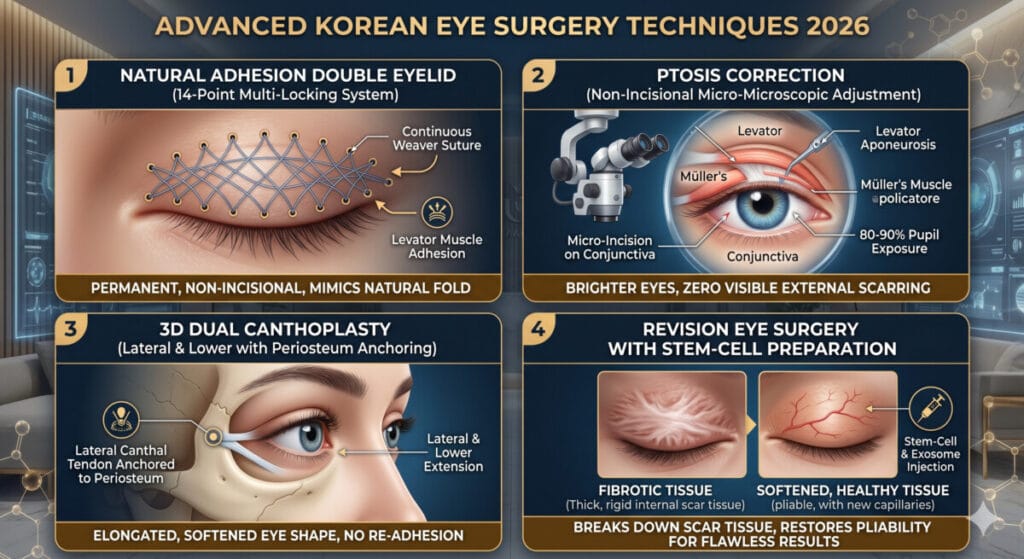
Natural Adhesion Double Eyelid Seoul: The 14-Point Multi-Locking System
The traditional non-incisional method relied on creating 5 to 7 simple puncture points to tie the skin to the underlying muscle. While less invasive, it carried a notable risk of unraveling over time. Today, the industry standard for double eyelid surgery in Seoul has shifted to the 14-Point Multi-Locking technique.
- How it Works: The surgeon creates microscopic, virtually invisible punctures along the designed crease line. A single, ultra-fine surgical thread is then continuously woven through these 14 points, interlacing the levator muscle and the dermis in a complex matrix.
- The Result: This intricate weaving induces natural micro-adhesions, mimicking the exact biological structure of a congenital double eyelid. It reduces the probability of the fold unraveling to less than 1%, ensuring a permanent result without linear scarring.
Ptosis Correction Korea: Non-Incisional Micro-Microscopic Adjustment
Ptosis is a medical condition where the levator muscle is weak, resulting in a sleepy appearance and premature forehead wrinkles. Standard double eyelid surgery alone cannot fix this; it requires adjusting the muscle tension. For patients without severe skin laxity, the high-end trend is Non-Incisional Micro-Microscopic Ptosis Correction.
- How it Works: Elite surgeons now utilize high-powered surgical microscopes rather than relying on the naked eye. Through tiny micro-incisions on the inside of the eyelid, the surgeon carefully folds and tightens the Müller’s muscle and levator aponeurosis.
- The Result: Microscopic precision avoids damaging the surrounding capillary networks, minimizing bleeding and post-operative swelling. The patient achieves a bright, full pupil (the ideal 80-90% pupil exposure) with zero visible external scarring.
Epicanthoplasty vs. Lateral Canthoplasty: The 3D Dual Anchoring Technique
Canthoplasty involves extending the dimensions of the eyes for a larger, softer appearance. Epicanthoplasty addresses the inner corner by releasing the Mongolian fold, while lateral and lower canthoplasty expand the outer width and downward slope.
A major historical pain point with lateral extensions was “re-adhesion”—the tendency of freshly cut outer corners to heal back together. The modern 2026 solution is 3D Dual Canthoplasty.
- How it Works: The surgeon performs both lateral (outward) and lower (downward) extensions simultaneously to maximize the visible white part of the eye. Crucially, the newly positioned lateral canthal tendon is meticulously anchored directly to the periosteum (the membrane covering the orbital bone).
- The Result: By structurally securing the tissue to the bone, the risk of re-adhesion is completely neutralized. The eye is permanently elongated and reshaped without an unnatural, “webbed” look.
Revision Eye Surgery Korea: Stem-Cell Tissue Preparation
Revision surgery is extraordinarily complex. When a previous surgery fails, the internal anatomy is often distorted, and the tissue is stiffened by hardened scar tissue (fibrosis). To ensure the highest success rate, VIP-targeted clinics performing revision eye surgery in Korea utilize pre-surgical Stem-Cell Preparation.
- How it Works: Weeks prior to the actual revision surgery, stem-cell culture fluids are strategically injected into the hardened eyelid. These are often derived from the patient’s own adipose tissue or high-grade exosomes.
- The Result: Stem cells stimulate rapid new blood vessel formation and cellular regeneration. This actively breaks down fibrotic bands, returning the tissue to a healthy, pliable state so the surgeon can create a flawless new fold.
The Reality of Pain, Risks, and Recovery
Understanding the objective reality of the surgical process helps mitigate preoperative anxiety and allows for proper travel planning.
- Pain Level (2-3 out of 10): The procedure involves brief, light sedation for the first few minutes while local anesthesia is administered. Patients feel absolutely no pain during the surgery, and post-operative throbbing is easily managed with oral painkillers.
- Day 1–3: Peak swelling and bruising occur. Intensive care, including continuous ice packing, is mandatory.
- Day 5–7: Suture removal takes place. This is the minimum safe point for boarding a flight home.
- Day 10–14 (Social Recovery): Swelling subsides enough to apply light eye makeup and confidently attend social events.
- Month 1–6: Minor swelling vanishes entirely, and the final aesthetic line is permanently set by the sixth month.
2026 VIP Premium Pricing Guide for Korean Eye Surgery
For international patients expecting a premium tier of service—which strictly includes professional medical translation, operating room CCTV access, and VIP aftercare—the 2026 price estimates are as follows:
- Natural Adhesion Double Eyelid: 3,500,000 ~ 5,000,000 KRW
- Ptosis Correction: 4,500,000 ~ 7,000,000 KRW
- Canthoplasty (Corners/Extensions): 2,500,000 ~ 4,500,000 KRW
- Complex Revision Surgery: 10,000,000 ~ 15,000,000+ KRW (Varies heavily based on existing tissue damage)
The Safe Choice: Why Direct Booking is a Risk
Many international patients attempt to book directly with clinics, assuming it will streamline the process. However, navigating Gangnam’s highly saturated medical market without an expert advocate is inherently risky.
Direct booking often leads to critical miscommunications regarding millimeter-specific design preferences. Furthermore, independent patients frequently miss out on vital, fast-tracked aftercare treatments because they simply do not know what to demand.
The Korea Beauty Guide Advantage
Korea Beauty Guide exists to eliminate these risks entirely, transforming a daunting medical journey into a seamless, luxury experience. Premium results require premium, uncompromising advocacy.
- Medical Translators, Not Just Guides: Eye surgery design dictates that a single millimeter changes the entire facial aesthetic. Korea Beauty Guide provides dedicated, highly specialized medical translators to ensure aesthetic nuances are translated with 100% distortion-free accuracy.
- 100% Safety Verification: Safety is non-negotiable. Korea Beauty Guide strictly partners with the top 1% of Board-Certified plastic surgery clinics. Every partnered facility is rigorously vetted for on-site anesthesiologists, emergency backup power, and legally mandated Operating Room CCTV access.
- Fast-Track Recovery System: Surgery is only half the journey. Korea Beauty Guide engineers a meticulously managed recovery protocol, scheduling premium laser de-swelling sessions and delivering prescription medications directly to the patient’s accommodation.
Do not leave your vision and appearance to chance or communication barriers. Contact Korea Beauty Guide today for a free, personalized consultation to discuss your aesthetic goals, review verified elite clinics, and experience the highest standard of international patient care in Seoul.